
The Backyard is My Grayscale Oyster

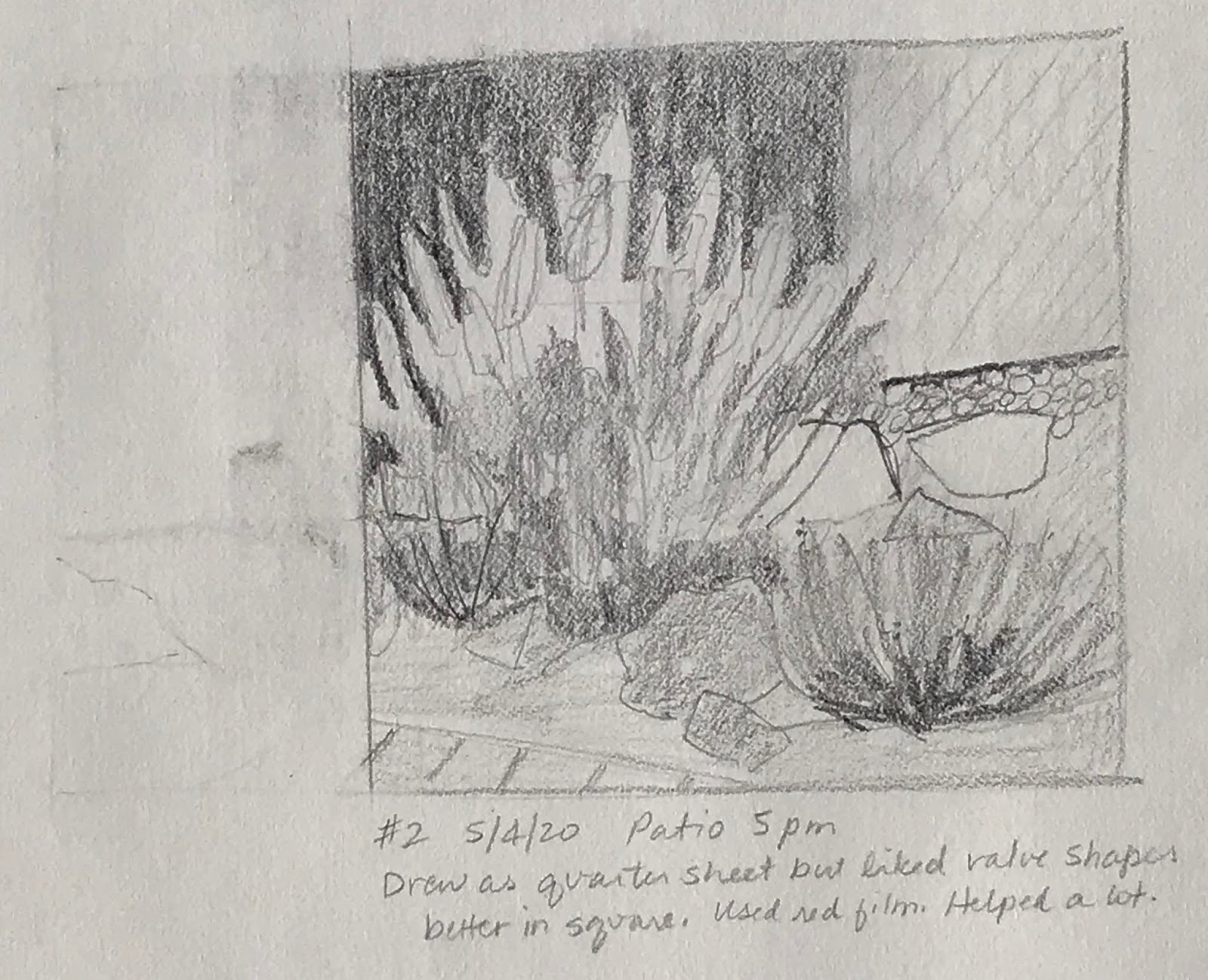
Oh, values. The bane of my art existence. Why can't I get this? We're talking basics here, but I just can't seem to translate what I see/want to paint into something that is effective from a value point of view. So for composition #2, I dug into my plein air bag (dusty from long storage), and pulled out some tools I bought years ago and never really used: the EASyL Viewfinder and ValueComp from Artwork Essentials.

Composition #2. Started as a rectangle but the
value masses looked better in a square format.
Since it was a beautiful spring day and we're still under shelter-in-place rules, I walked around the backyard with the red film to my face until something came into view where I could see three distinct values (light, medium, dark). It actually wasn't easy to find. Most everything was mid-tone. Anything I would have considered painting in the past was mid-tone. Even light shading an object was not enough to create a "value mass," as Ian Roberts says is necessary for a compelling composition.

I finally found some late afternoon light creating some hard shadows across the herb garden and onto the back wall of the house. Not the best scene, but it would do. I positioned my chair to divide up the space and started to draw. This little drawing, approximately 4" square, took me 45 minutes! I hope to improve that timing. If I were outdoors to paint, the sun would already be in a different position from what initially attracted me. And a lot of the time, I'm squeezing an hour of art time into my life, so that only leaves 15 minutes to paint. Definitely need to get quicker at these compositions.
Comments

Popular posts from this blog

Mean Critic Meets Scary Progress

I'm continuing to work on my value studies and bouncing all over the place, both with subject and with medium. I swear that one of these days I'll find my lane. There are things I like and dislike about oils, acrylic, and watercolor. There's not a perfect medium, but oils sure are easier for working on composition and value.  As the year is coming to an end, I'm wrapping some things up and getting ready to launch other things. I went through my last three years of paintings (about 150) and categorized them as keep for myself, make available for gifts or purchase, or repurpose (at first I had labeled them trash, but that just seemed so mean, and I really can use the paper for other things). With the gift/sell category, I created a PowerPoint file with all available paintings, categorized by subject. Each was labeled and priced...a scary declaration on my part that my creativity is valuable. In the coming year, I will use this file to create a new website for my growing a...

Down the Value Study Rabbit Hole

What's the best way to create a value study for me? I'm trying to figure that out. And how to paint from it once I've done it? I'm trying to figure that out, too. Been re-reading Ian Roberts' Mastering Composition . Have re-dedicated myself to working on a value composition a day (my original goal). He promises that a year of these daily compositions will make a HUGE difference in my art. Even with the few I've done, I'm seeing improvement and I'm asking a lot more questions, which I think means I'm on the right track for me right now.   Overall, I've done five value studies of the rose, and it's getting tedious. But each one had me asking another question, so I continued on. It was a great exercise, trying different methods. I should have done one last one, a pencil sketch, but I've run out of steam. What's interesting, though, is that they all look similar yet different. Referring to the quad image at right, the simplest studies (3 ...

Value Epiphany!

For the new year, I've decided that before I start a painting, I'll note the goals for that painting session and/or the finished product if I'm not painting alla prima (in one session). I've sort of informally been doing this for the last couple of months, but now I want to consciously follow these steps: 1) write down my goals, 2) paint, 3) acknowledge that the painting is crap ( see previous post ), 4) note how I did or did not meet my goals, and finally, 5) create a next steps list. Of course, these steps won't be executed until I've done the all-important value studies! Last October I painted a lesson from Dreama Tolle Perry's Flow class , a cute carafe of cream with a white ceramic basket of strawberries. The basket didn't read "white" in my painting, which I didn't like, and I wanted to figure out why...but I wanted to use my own still life to do it.  So I set up a scene informed by Dreama but all my own. My scene used my own props to...