
Five Minutes. Go!

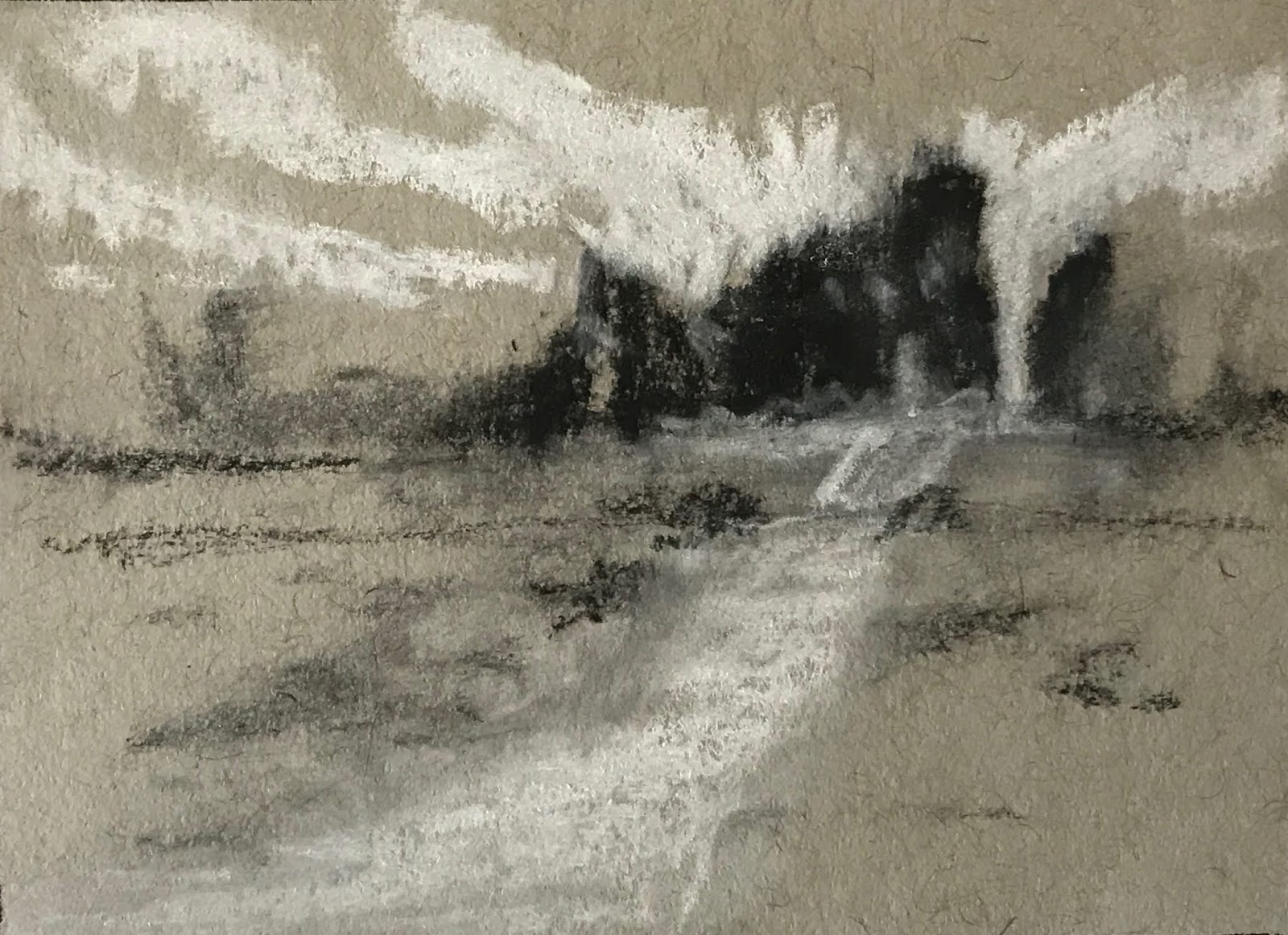
Composition #12, working on value masses.
Today I challenged myself to create my value composition in five minutes. The goal was to construct a landscape, loosely based on a photo I took at Arches National Park, with a focus on distinct value masses. I set my timer and got to work. When it buzzed, I took a few more minutes to see if I had a "papa, mama, baby" distribution of lights, darks, and mid-values. I didn't, so I reworked the composition a bit until I did. Success. Papa: mid-tones. Mama: white. Baby: black.

My finished landscape. 
I then worked out a color palette for my small (5"x7") test painting, choosing a triadic color scheme of yellow ochre, naphthol red, and both phthalocyanine blue and ultramarine blue. I added in titanium white and that crazy baby blue I'm using up (see it in the sky), and started painting. My goal: staying true to my value plan.

Overall, I'm pleased with my little painting. I think it holds true to my value plan, the color is attractive and holds true to the triadic scheme, and it's a pleasant scene. My only issue is that it doesn't express what I was feeling the day I took the photo, so I'm back to the studio to try a few different versions. I'll keep you posted on my progress.
Comments

Popular posts from this blog

Mean Critic Meets Scary Progress

I'm continuing to work on my value studies and bouncing all over the place, both with subject and with medium. I swear that one of these days I'll find my lane. There are things I like and dislike about oils, acrylic, and watercolor. There's not a perfect medium, but oils sure are easier for working on composition and value.  As the year is coming to an end, I'm wrapping some things up and getting ready to launch other things. I went through my last three years of paintings (about 150) and categorized them as keep for myself, make available for gifts or purchase, or repurpose (at first I had labeled them trash, but that just seemed so mean, and I really can use the paper for other things). With the gift/sell category, I created a PowerPoint file with all available paintings, categorized by subject. Each was labeled and priced...a scary declaration on my part that my creativity is valuable. In the coming year, I will use this file to create a new website for my growing a...

Down the Value Study Rabbit Hole

What's the best way to create a value study for me? I'm trying to figure that out. And how to paint from it once I've done it? I'm trying to figure that out, too. Been re-reading Ian Roberts' Mastering Composition . Have re-dedicated myself to working on a value composition a day (my original goal). He promises that a year of these daily compositions will make a HUGE difference in my art. Even with the few I've done, I'm seeing improvement and I'm asking a lot more questions, which I think means I'm on the right track for me right now.   Overall, I've done five value studies of the rose, and it's getting tedious. But each one had me asking another question, so I continued on. It was a great exercise, trying different methods. I should have done one last one, a pencil sketch, but I've run out of steam. What's interesting, though, is that they all look similar yet different. Referring to the quad image at right, the simplest studies (3 ...

Finishing My Acrylic Complementary Study

I'm rereading Carlson's Guide to Landscape Painting, as I've decided that I really miss painting landscapes, especially in plein air, but the reason I stopped doing it was because I wasn't happy with my results and I wasn't making progress (ugh, watercolors!). Carlson's book is  DENSE. I gave up highlighting it because almost every paragraph would need a highlight, but I am typing up notes as I read, with the hopes of eventually creating a cheat sheet for myself.  One of the first lessons he writes about is his "theory of angles," where, for an average landscape, the sky, ground, trees, and mountains have certain relative values. Thinking about the six studies I just completed , I realized that I had arbitrarily assigned the sky a mid value, to make the house more the focal point, but according to Carlson, the sky should be the lightest value of the natural objects. Oops. So I redid the value study, using his theory. I kind of like it. Looks more ...